Can’t hurt if the sun shines either — for more than an hour or two.
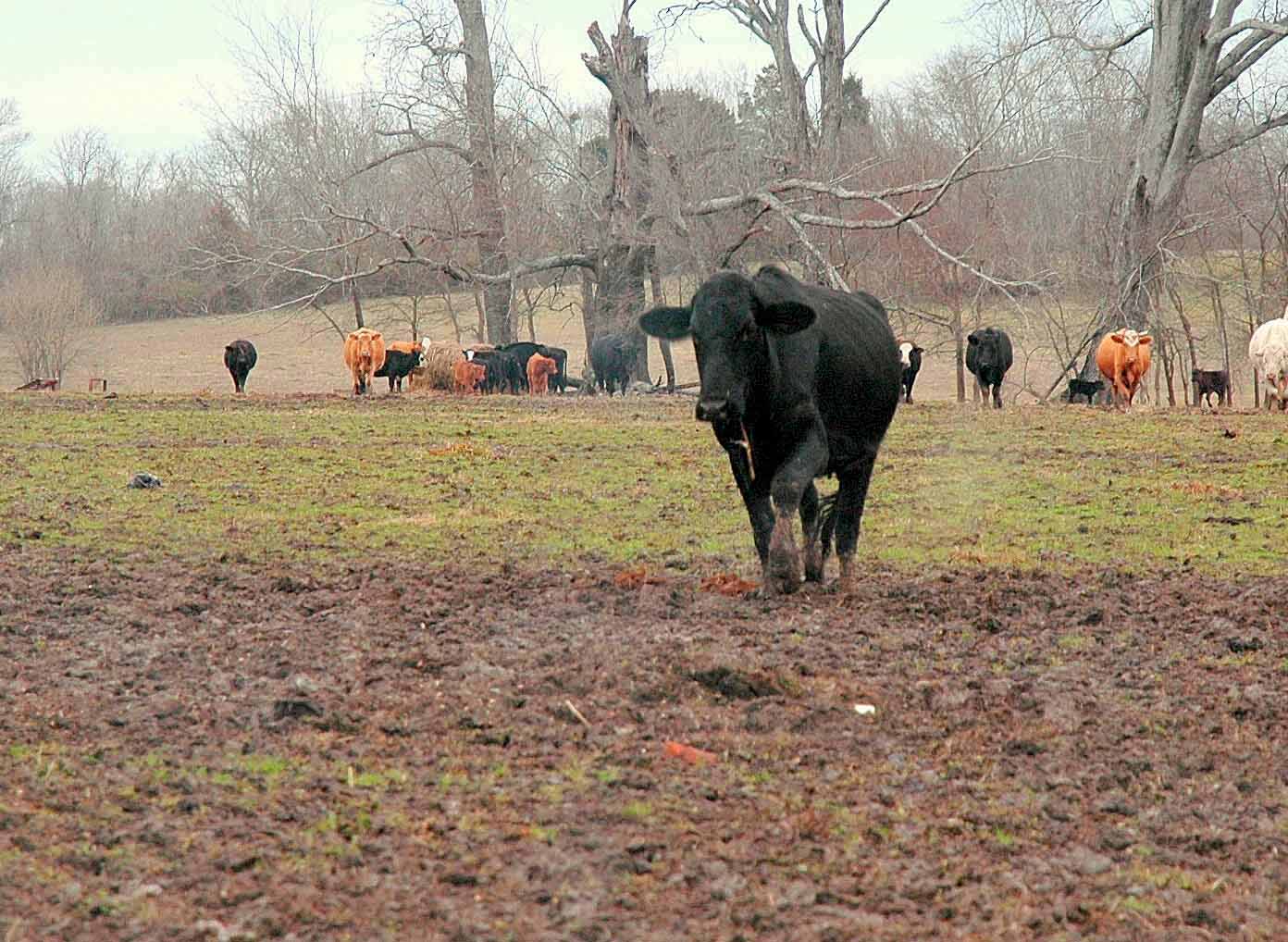
And if I read any Facebook posts where people say they are thankful for rain because of the flowers it will bring, well…they can just go take a walk in a pasture!
Let 'em wade through mud up to their knees.
Let 'em drive a truck through the seeps.
Let 'em try to pull an animal out of a ditch.
Let 'em stretch five bales of hay into 50 because it's too cold and wet for grass to grow.
Not only that, but this has been one extended miniseries of a winter!
It all started last year. If those cold rains weren't enough, the rains of this year have been absolutely CHILLING, kind of like Misery, if you know what I mean!
So now we have Cryin’ in the Rain II.
It’s so wet that farm trucks are covered in mud. There’s no sense washing them, because like determined little boys, they just go right back out and get covered in mud again.
It was so wet last year that ducks and geese turned a nearby hayfield into a habitat. They swam where I have never seen fowl swim before.
It’s so wet and so gray that for once the groundhog didn’t see his shadow. So maybe, just maybe, spring is coming soon!
But unlike Groundhog Day (the movie), I’m hopin’ next winter doesn’t repeat this winter all over again…and again…and again!
I live in SEC Countrywhere college football is way of life, and tailgate picnics are major social functions. Just watch an ESPN Game Day preview to see the zealous fans and what’s cookin’ in the parking lot. Then, in the case of my alma mater, note the crowd’s devotion as Auburn’s eagle lifts off for itsinspiring flightthrough the stadium.
That “War Eagle” battle cry coupled with the eagle release is a grand tradition, but before an eagle ever landed on the plains, there was a bitter college rivalry across Central Alabama, and it wasn’t about football.
The competitors were my hometown of Greensboro and my college town of Auburn, and the prize was an institute of higher learning. Now, I might mention that Methodists and the media were the chief cheerleaders for each side, and despite initial rejection, Auburn owes much to those Methodists. Otherwise, the state’s “cow college” where I really could see cattle from my dorm might not exist!
Disagreement over location of a new denominational college began back in the mid-19th Century when southern planters decided they wanted their sons educated closer to home. Why send them up north to Yale and Harvard when they could build a fine institution in the South? So, in 1854 when the Alabama Methodist Conference met, its delegates deadlocked on a choice between Auburn and Greensboro, and they voted to award the prize to the town offering $100,000.
A race to raise funds began, prompting a war of words from west to east and east to west. One delegate who supported Greensboro even took the floor at one meeting and declared that East Alabama should not be considered, because he had visited the area, and “Everywhere I went, poverty stared me in the face!”
The editor of the Auburn Gazette responded by asserting that Auburn was best, because its citizens weren’t rowdy like the ones in Greensboro. In fact, he warned, the West Alabama community found it necessary to pass laws against drunkenness, fighting and swearing. Then, he further stoked the “discussion” when he said that Greensboro was “located in a sickly prairie area” and could only be reached by bad roads.
The editor of the Greensboro Beacon admitted that while there was some disorder in the town, under no circumstances was it sickly!
When the Conference met again in the Dallas County town of Summerfield, Greensboro produced pledges of $113,000 compared to Auburn’s $100,000. Since both had raised the required amount, a committee was appointed to solve the dilemma. Greensboro won the committee’s support, but the group suggested locating another college at Auburn. Greensboro delegates disagreed, saying the conference could not support both.
Still, the controversy wasn’t over. A few months later, Greensboro out-pledged Auburn again, even bringing three supporters who were ready to increase the sum if necessary. Yet, delegates debated the issue for three more days!
Greensboro finally won, but Auburnites were so incensed confident that they determined to build their college anyway. So, the East Alabama Male College (known as Auburn even back then) was chartered in 1856, the same year as The Southern University in Greensboro. Later, the Methodists agreed to take on Auburn’s institution as well.
But when the War Between the States took its students to battle, Auburn had to close.
After reopening in 1866, times were so hard that by 1872 the Methodist Church transferred control of Auburn to the State of Alabama. It became a land-grant institution under the Morrill Act, and its name was changed to the Agricultural and Mechanical College of Alabama. Later, the college was renamed the Alabama Polytechnic Institute and still later, Auburn University.
Today, Auburn is one of the largest universities in the South, and its outreach benefits millions worldwide. But over here in the Black Belt, we especially appreciate the Cooperative Extension programs,agricultural researchandRural Studio.
So what became of Southern University?
In 1918, it merged with Birmingham College to become one of the finest liberal arts institutions, Birmingham Southern College.
Unfortunately, the university's grand Tudor-style building that later housed other schools and was the major architectural landmark of Greensboro was destroyed by a tornado in 1973.
This sunset along County Road 38 in Perry County, Alabama is one of the most spectacular I've ever seen. Perhaps that's because it arrived shortly after the dark clouds and rain from a tropical system departed. (Double click the photo for a larger view.)